
By Barbara Pierce
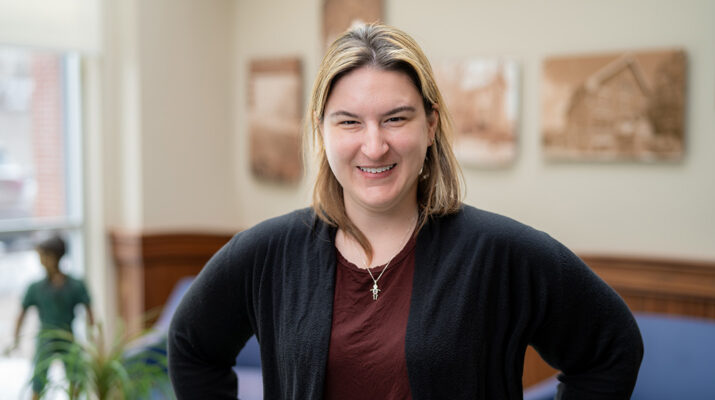
Licensed clinical social worker Heather Reynolds is employed by the Neighborhood Center, Inc., a nonprofit organization in Utica that provides a broad range of outreach, preventive, developmental and therapeutic activities to benefit children, families and the community. They provide services for more than 63,000 children and their families in the Mohawk Valley.
We recently interviewed her about her career.
Q: You are enthusiastic about your position at the Neighborhood Center and what the Neighborhood Center offers to our community. How did you become interested in a career as a licensed clinical social worker?
A: I minored in psychology at Utica College. That led me to think about a career in the field. I recognized that social work would be a good fit for me and it would be a way I can really help people. Social work is one of the fastest-growing professions in the U.S. Professional social workers are the nation’s largest group of mental health services providers, according to the Substance Abuse and Mental Health Services Administration online.
Q: What training did it take to become an LCSW?
A: After I graduated from Utica College, I got my Master of Social Work degree from Syracuse University. After graduation, I got licensed.
An MSW degree generally takes two years to obtain. Syracuse University offers both full-time or part-time study on campus or online part-time. The program combines classroom learning with hands-on experience in an internship. It also prepares graduates to earn their license as an LCSW.
To obtain an LCSW requires a master’s degree in social work, three years of post-MSW supervised experience, passing a clinical exam and completing all the required coursework and training.
Q.: How long have you been with the Neighborhood Center?
A.: I started at the Neighborhood Center in January 2013. I started seeing clients, then I was then promoted to clinical supervisor in the Behavioral Health Clinic.
Staffed by a team of professionals, psychiatrists, psychologists, social workers and counselors, the Behavioral Health Clinic provides clinical, crisis and community-based services for children, adults and families that struggle with mental health issues or addiction.
In the middle of October, I was promoted to director of the school program. I’ve just started this new position. We have multiple satellites in local schools, mostly in the rural areas. Our staff go to each school a few days a week. Any child who is struggling can be referred, either by their primary care physician, another agency, their teacher or a parent.
We have such a huge variety of services at the Neighborhood Center, services to help children and their families. Readers should check out our website: www.neighborhoodctr.org to see the details of the many programs we have.
Q.: What is the best thing about your position with the Neighborhood Center?
A.: There are so many really good things. One is I see people at their low point, then see them later, successful in changing their life in positive ways. I see kids who got into trouble often, then see them graduate from high school or even college. Or the young child with temper tantrums. A few months later, they’re doing good.
Q.: What are some of the challenges you face?
A.: Burnout is a very real challenge. A need for more community resources is another challenge. There are many great agencies out there that we work with, but there are several areas for growth in this area.
Q.: What qualities does it take to do the work you do?
A.: It takes the willingness to learn and the ability to collaborate with other agencies. It’s always challenging to learn new things. One needs to be flexible and always be ready to roll with the punches.
Q.: Anything else you would like people to know?
A.: People know about MCAT, our crisis response team. MCAT is available 24 hours a day, seven days a week, 365 days a year for children or adults in crisis. The team responds to crises where they occur face-to-face, virtually and on the telephone. They operate a local crisis line, the 988 line and a mobile crisis response for the Mohawk Valley region. There is no fee for MCAT services.
People don’t know about the many other services we offer to families and individuals, like behavioral health, case management, adult recovery post adoption, services to veterans, and many, many programs for kids.
The Neighborhood Center offers so much to our community. The best way to learn more about us is to see our website www.neighborhoodctr.org or call 315-272-2600.