

Researchers find life expectancy varies dramatically based on where we live, economic conditions and race and ethnicity.
By Barbara Pierce
 Just how long you’ll live is largely determined by where you live.
About 25% of your lifespan is determined by genetics, according to the National Library of Medicine. We’re all familiar with lifestyle factors, not smoking, eating right, drinking minimally, maintaining a healthy weight and staying physically active.
While these are significant, another factor you may not have considered is where you live.
Recent studies estimate that more than 75% of our lifespan is driven by environmental and social factors related to where we live. A range of powerful evidence shows unequivocally that where we live plays a huge role in our health.
“There are striking disparities in life expectancy across the U.S.” said Ali Mokdad, professor, health metrics sciences at the University of Washington. Mokdad has led several major studies on life expectancy in the U.S.
Mokdad and other researchers have found that our life expectancy varies dramatically based on where we live, our economic conditions and our race and ethnicity. U.S. life expectancy is heavily influenced by these factors and shows a widening gap between the highest and lowest groups. His research shows that life expectancy in the U.S. can range from more than 85 years for certain populations to less than 64 for others, with significant disparities due to risk factors like smoking, obesity, and lack of access to care.
That’s a gap of more than 20 years.
“This is way worse than any of us had assumed,” said Mokdad.
There are four things driving these differences in who lives and who dies in America, Mokdad explained:
“First is your socioeconomic status, meaning your income and education,” he said. “You’re more likely to take care of your health if you’re educated. And your income, which is probably higher, gives you the ability to do that.”

Research has found a painfully high correlation between household income and life expectancy.
“Second is access to health insurance,” he added. “There are many people in the U.S. who don’t have health insurance. And for many who do have insurance, it doesn’t cover preventive care. In other countries, everybody has access to health care. I was born and raised in Lebanon. There the government pays for health care for everyone; they don’t have to worry about their health.”
“Next is the quality of medical care. A patient may have a condition diagnosed by their doctor. But how well is that condition treated? The quality of medical care varies across the U.S. It’s sad to see what’s happening,” he continued. “We spend more money on health care than anybody elsewhere in the world. Are we getting a return on our investment? No. We are not. The return on our investment is fairly miserable.”
“This one is most important,” he said. “Prevention. Things like obesity, smoking, high blood pressure and diabetes can be prevented. Since the 1990s, we’ve had an obesity and diabetic epidemic. Smoking has declined, fortunately. But obesity and diabetes are becoming a major health concern.”
“We do have medications for obesity and diabetes. But they’re so expensive nobody can buy them,” he continued. “I worked in the CDC in the ‘90s when high blood pressure medication first came out. It was very expensive; not everybody could get it. It took a while for the cost to come down so people could get it. The government decided to make it available.”
Mokdad is especially concerned about the discrepancy among ethnic groups.
“Native Americans have lost life expectancy; Asians have lost the less of any group. In our studies, we found a wide gap between Native Americans and Asians. Some of us are left behind. For me, the question is what should we do?” he continued. “We need to change the way we eat. Many people have a poor diet, many overeat. Healthy food should be more accessible. Our system doesn’t support healthy eating. Why can’t we make fruits and vegetables accessible and cheap? And our educational system needs to change. Why can’t we make colleges free for everyone?”
Regarding life expectancy in our area, New York state remains among the top-ranked states in the US for life expectancy, significantly better than the national average. Data from November 2025 shows New York state residents live an average of 81.0 years. The U.S. average is 78.5 years.
Researchers found that state policies have a strong influence over life expectancy. Policies such as stronger gun control, drug overdose prevention, Medicaid availability and safe abortion access are drivers of the divides in life expectancy between states.
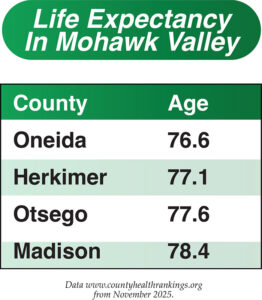
Regarding the Mohawk Valley, the breakdown by county (from November 2025): Oneida County: 76.6; Herkimer County 77.1; Otsego County: 77.6; Madison County 78.4. (This data is from: https://www.countyhealthrankings.org/).
There are websites where you can enter your zip code and learn life expectancy for your zip code; one such website is the Robert Wood Johnson Foundation.