

Audiologist at Bremer Hearing Audiology talks about hearing loss and health complications and how AI is making hearing aids more efficient
By David L. Podos
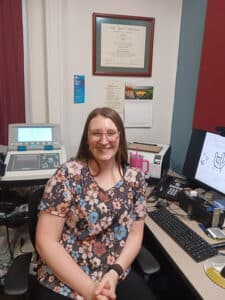 Q: What is your title?
A: I am a doctor of audiology.
Q: To be an audiologist, what kind of education do you have to obtain?
A: First, you have to complete an undergraduate degree. That major is pretty much left up to the student. However, most students will choose speech language pathology with an introduction into audiology as their undergraduate work. After that, if you decide that you want to be an audiologist, you have to go into graduate school, which is another four more years of study. In the last year the student will do an externship. So, that whole last year the student is not in the classroom anymore, rather you are at a clinic, a private practice, an ENT clinic, a Veterans system. All of this is very similar to what a medical doctor goes through in residency, working directly with patients.
Q: Why do so many people who experience hearing loss are reluctant to admit that they have a problem?
A: Typically hearing changes over time. So, the loss is gradual. Our brain, which is amazing, will say how can I compensate for this hearing loss. For example, people might find themselves paying more attention to looking at a person’s mouth when they are speaking. That might help them temporarily to understand what is being said. Even if the hearing loss increases, the person will often say, ‘I can hear you just fine.’
Q: Can a person, particularly if they are younger, deny that they are having a hearing loss because often that equates to people who are old?
A: Absolutely. Oftentimes they will say I am not old enough to be wearing hearing aids. But the truth is hearing loss does not discriminate. You can be born with a hearing defect from a genetic disorder or someone can contract meningitis which causes hearing loss. There are many disease states that can cause someone to lose hearing.
Q: What about certain occupations?
A: Sure, when you get into occupations that cause hearing loss we are talking about excessive noise for long periods of time, like machinery and or construction, military and or law enforcement with the loud sounds of guns. Even riding a motorcycle long enough can cause hearing damage.
Q: The ears are amazing, but they are quite sensitive, aren’t they?
A: Yes, for sure. We have these tiny, microscopic hair cells and that’s what gives you sound. It rubs up against our auditory nerve giving stimulation to the brain and when you develop hearing loss that’s what goes first. You are losing those hair cells. They start to bend, break, and eventually die.
Q: Can the hair cells come back?
A: They cannot. There is research ongoing right now trying to figure how we can do that. If and when that should happen it will be a game changer for those with hearing loss.
Q: It seems that AI is changing the world in many ways. One of the disciplines that has great promise for the use of AI is in medicine. How can AI help with hearing loss?
A: AI already is having a positive impact on our profession. For example, hearing devices at this point already have AI capabilities in them. Essentially the AI technology inside the chips of the hearing devices can help detect sound better. It makes good hearing devices smarter and that is always a plus for our patients.
Q: There has been news lately which I am sure you are aware of, on the correlation between hearing loss and dementia. So, what is that all about?
A: I think there is a lot of fear mongering that says, if you have hearing loss you will absolutely develop some form of dementia. It is not a cause, but rather a correlation. So, when we see people who have untreated hearing loss, say in the mild degree range, research is showing that they are two times more likely to develop dementia.
Q: Why is that?
A: It all goes back to the brain. The brain being your third ear, it makes sense of everything in the world. Our brains do not like to leave anything undone. As we develop hearing loss what we are seeing is that people become more withdrawn. For instance, they may say, I don’t want to go out to that restaurant and hang out with those people anymore because I am not hearing them very well, so, I am going to stay home. That loss of social activity, being more socially withdrawn, leads to that correlation with dementia.
Q: I noticed in your waiting room a phone that was closed captioned. What is actually is aclosed captionedphone?
A: That is a technology that is offered worldwide and we do offer it to our patients. Basically, it allows a person to read on a screen what they are saying. This service is free, all we have to do is have the patient fill out an application. The audiologist then signs off on the application saying that this person does have a hearing loss and needs a closed captioned device.
Bremer Hearing can be contacted at (New Hartford office) 315-735-3536 or (Rome office) 315-337-0654