
By Jolene Cleaver
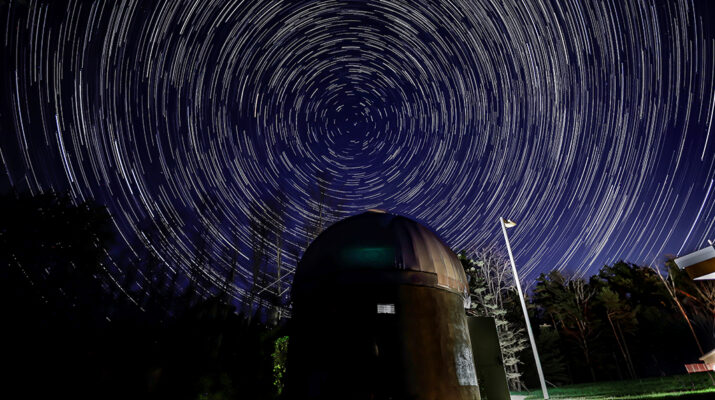
On a crisp winter night in Upstate New York, when snow softens the landscape and the cold air feels almost electric, the stars offer a reason to step outside.
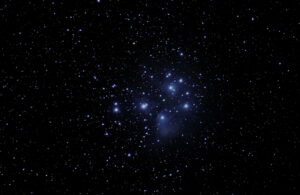
From the quiet hills of the Mohawk Valley to the Adirondack foothills, features such as Orion and the Pleiades shine in the night skies, reminding us that even in the year’s darkest months, there’s beauty waiting just beyond the front door.
For many, winter means hibernation, but getting outside, even briefly, can do wonders for body and mind, local astronomers say.
Stargazing is one of the simplest, most peaceful ways to reconnect with nature during the colder months, no equipment or athletic skill required. The season’s long nights and clear skies make Upstate New York a perfect place to look up, slow down and breathe in the quiet.
We recently caught up with three area sky watchers to get the winter lowdown on the nightly heavens.
“The winter sky has really bright stars,” said Faith Thompson, the observing coordinator with the Mohawk Valley Astronomical Society.
She said telescopes can be awkward to carry and set up in the cold, but “binoculars might be great.”
Thompson said good viewing spots in the Mohawk Valley include areas away from light pollution.
“It’s going to be dark around dinner time,” she said, adding the Starr Hill area in Remsen might be a good place. Or check out public trails like the Rayhill Trail in Whitesboro. Maybe on any of the Erie Canal Trails.”
For anyone new to the hobby, she suggested joining public stargazing events.
“People don’t go out much in the dead of winter,” she said, adding that it can be cloudy and cold but still rewarding when the sky clears.
Thompson said technology can make it easier. There are apps on cell phones that map celestial events.
What to see
“Saturn will be up all winter. Jupiter by the end of December. Jupiter’s moons can be seen with good binoculars,” Thompson said.
She added that through the winter, constellations like Orion the Hunter will be visible. Further, below Orion’s Belt, Thompson said, “is a fuzzy star. It’s actually the Orion Nebula, a stellar nursery where new stars are being born.”
It is seen as the middle star in the sword of Orion, which are the three stars located south of Orion’s Belt. The star appears fuzzy to observers and the nebula can be observed through binoculars or a small telescope.
What else is up there this winter?
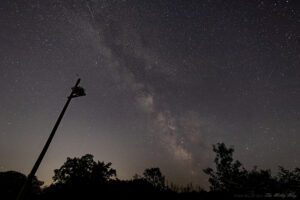
Among suggestions for winter sky viewing, Thompson adds that groups heading outdoors can look for the Milky Way, which can also be seen with the naked eye, along with the pleiades star cluster also known as the Seven Sisters which will next experience an occultation in early December.
“The moon is always neat,” Thompson said. “It’s a great moment to learn about craters and there
are features to be seen with the
naked eye.”
Kamal Jabbour, a visiting scholar at SUNY Oswego who also runs the Pompey Observatory, added, “There will be a full moon every month.”
He said this winter, Saturn will be visible in the evening sky.
He recommends the website Stellarium-web.org, a website that shows you what’s in the night sky at any given time even in the distant past.
“All interesting things are going to rise in the east and set in the distant west,” Jabbour said. “This winter, you may be able to see Andromeda and Triangulum — both more than two million light years away. They are the farthest objects that can be seen with the naked eye.”
Jabbour’s winter constellation picks also include the Orion constellation which is highly visible throughout winter, as well as Ursa Major and Polaris.
“That is the first thing I tell people to look for. Look for the big bear (Ursa Major) and then go from the base five times that distance and you get to Polaris, the North Star,” he said.
Jabbour recommends driving to Inlet or the Adirondacks for less light pollution.
“Inlet is a good place just past Old Forge. Or if you drive south, head toward Route 20. … I advise people, get a blanket, lie on the (ground), look straight up, get their eyes acclimated and they will see the Milky Way. They will see all of these,” he said.
According to John Zielinski, a retired visiting assistant professor in the Department of Physics and Astronomy (SUNY Oswego) and now volunteer at public telescope programs at the Rice Creek Field Station Observatory, Jupiter will be of interest to see in the night sky. Jupiter is the brightest object in the sky after the moon.
He listed dates when Jupiter will appear at specific times:
Dec. 15: 2:06 a.m.
Jan. 1, 2026, 12:55 a.m.;
Jan. 15, 2026: 11:52 p.m.;
Feb. 1, 2026: 10:31 p.m.;
Feb. 15, 2026: 9:31 p.m.;
Mar. 1, 2026: 8:33 p.m.;
Mar. 16, 2026: 8:37 p.m.”
What’s more, Zielinski said Jupiter’s moons can be seen with binoculars “if hands can be steadied.” He added that you would need binoculars with 7X magnification at least. But 10X would be better.
Also of interest in the sky this winter, the International Space Station will fly by before midnight on the following evenings: Jan. 10–30, 2026 and March 9–29, 2026.
“Consult a website to get the exact times for the fly-over,” he said. “These websites also supply a sky map that shows the path of the space station.”
Between bright constellations, visible planets and the glowing band of the Milky Way, winter skies across upstate New York offer a show worth bundling up for.
Stargazing can mean a walk along a trail, a short drive to a darker hilltop or a few quiet minutes in a backyard, but Thompson said it’s the act of getting outside that matters most.
“It can be cloudy and cold,” she said. “But when the sky clears, it’s magic.”
Resources
• Check out telescope observation events at SUNY Oswego’s Rice Creek Field Station: https://calendar.oswego.edu/group/rice_creek_field_station/calendar.
• See organized events hosted by the Mohawk Valley Astronomical Society at: www.mvas-ny.org/
• See a trove of videos of all things space at Pompey Observatory on YouTube: www.youtube.com/@PompeyObservatory
• Track the International Space Station online at: www.nasa.gov/spot-the-station/
• Visit https://stellarium-web.org/, an online planetarium website that provides real time and historical night sky data, with apps also available in Google Play and the App Store.