
Occupational therapist manager at Central Association for the Blind and Visually Impaired in Utica discusses how the nonprofit helps those with vision issues, unveils a program that offers eye exam and free glasses for children
By David L. Podos
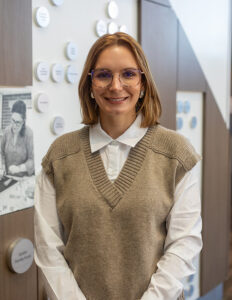 Q: What is the mission of Central Association for the Blind and Visually Impaired?
A: We assist those that are visually impaired to get to their highest level of independence.
Q: What is the difference between someone who is visually impaired and someone who is blind?
A: Legally blind are those whose acuity is in the range of 20/200 in both eyes. That can also go up to very high numbers, such as 20/800 or above in both eyes. Also, those who are only able to see light, hand motions or shadows, also fall into the category of being legally blind. So, the majority of clients that we service typically fall into that range. We do offer services to those who are totally blind. However, those numbers are much lower.
Q: How important is it that you identify early on that someone has an eye condition?
A: That is very important so treatment can start early. We have a program called pre school vision screenings. It is a free service that we provide to school districts and day care facilities. The ages are 3-5 years old. We test for near vision, distant vision, color vision and eye muscle imbalance. We have been providing this service for the past 20 years.
Q: How do these kids receive this service?
A: CABVI will travel to different school districts. So, let’s say that we are in one specific school for the day. We will screen the children there. We offer this service to school districts in Oneida County, Madison County and Herkimer County.
Q: How do you identify the child that your team will be working with before you go into the school?
A: First off, we send to the school a permission slip. That permission slip gives the schools administration an outline of the program and our services. That slip is then sent home to the parents and that’s how we know who to screen as the parents make the decision that they want this service for their child. So, when we go into the school we already have a roster with the names of the students that we will be working with.
Q: Are you finding many children that have eye problems?
A: Yes. Last year we screened 891 children and from that we referred 209 for eye exams.
Q: So, you are referring these kids for care. Who do you actually refer them to?
A: They can go to their own family eye doctor if they have one. Once we ascertain that the child has some eye issues we send to their homes a parent letter [explaining] that their child has been screened and we recommend a follow-up exam. We give them a list of providers. So, the parents in the end pick where they want to bring their child to.
Q: Does CABVI offer any financial assistance to families who cannot afford to send their child to an eye doctor?
A: We currently have a grant program that at this time is restricted to only Herkimer County, called Upward Mobility. That program pays for two free pairs of glasses for children, as well as a complimentary eye exam. We give the family a voucher they can use at either Wadas Eye Group in Herkimer or Towpath Vision Care located in Little Falls.
Q: How long has CABVI had the grant?
A: This is an exclusive for In Good Health. It is brand new! We also are hoping we can expand this service to other counties in the future.
Q: What kind of eyes diseases are you seeing in these young children?
A: We are seeing a wide range of conditions. It can be anything from juvenile glaucoma, cortical vison impairment, nystagmus which is a condition where the eyes actually move involuntarily back and forth and or up and down. We also see kids with retinal detachments.
Q: I assume that you and your team here in the occupational therapy department do some “hands on” work to help children with eye issues?
A: Absolutely. We do vision therapy for those children that are visual impaired. A lot has to do with their eye movements. So, we are rehabbing their eyes. Let’s say the child is struggling in school and the child cannot copy from the board. They are not able to shift their gaze back and forth and their eyes are fatigued and or getting double vision. We can help with that. For example, we have tools that we can use to decrease the double vision by using a machine called a Vector gram. That machine utilizes special slides or prints and trains the eye towards proper alignment.
Q: Where does the funding for CABVI come from?
A: We get monies from New York State Commission for the Blind and various grants and third-party billing.
For more information on these services as well as other services that CABVI provides, visit www.cabvi.org or call 315-797-2233.